January 26, 2012

Authentic Moss


was 9 months pregnant with my son Bobby, and considered myself a lucky designer. In 1997, the world was my oyster, professionally and personally. Four years out of graduate school and into a professional design career, our studio, Boym Partners, was rocking the supermarkets of Europe and the aisles of Target with plastic containers produced by a revolutionary German company called Authentics. All of a sudden, I found out from a friend that the go-to NYC design retailer, MOSS, was paying attention to our work.

I finally met Murray and Franklin outside their store re-arranging the window display of our studio’s plastic containers one midnight coming out of a late movie at the Angelika Film Center across Houston Street. In a beautiful high/low moment, the former Metro Pictures Gallery window looked like a supermarket shelf (well, almost). The window display was bursting with $2.25 plastic containers. It was one of the first of many of MOSS’ gutsy signature moves, the highbrow retailer championing cheap mass-produced design objects. For the record, the set of 8 Moss-curated Boym containers in a plastic bag cost $20.00, plus tax. There is a big price gap from $20 containers to a $20,000 sofa. For Murray Moss, the design quality could lie in all things, and he was eager to prove it to incredulous New York public.

MOSS, standard bearer extraordinaire, put their money where their mouth is. Despite what critics say, the MOSS perspective on design is not an elitist view. It’s only sincere and pure expression of a better life through design. And to guild the lily, they and their handpicked and trained staff lovingly organized many memorable exhibitions and parties. You can ask anyone in the design world who was there. I have been blessed to have been one of their designer/artist collaborators and friends for 16 years. I’d love to disclose many other memorable (design) controversies we survived together, but that history is still being written. There’s a bright future ahead for these boys starting the MOSS BUREAU.

Laurene Leon Boym


January 9, 2012

The Gift


On my recent trip to the south of India, I managed to get hold of a bicycle and pedaled through villages outside of Pondicherry, to a great excitement of local population. Children and youngsters, especially, seemed to be taken by a sight of a tourist on a bike with a camera. “Picture, picture!”– this cheerful and insisting call I would hear again and again. At first, I thought the villagers wanted to get paid a little for posing for the shot. This presumption proved wrong. Far from expecting the tip, they were sincerely surprised at the offering of money. Even though normally I am hesitant to take pictures of people, here I ended up with a small portrait gallery.

These encounters, so characteristic of India, are a curious phenomenon – like a souvenir in reverse. The Westerners always try to take something from a journey, to get a possession of something local for a good memory. Those Indian teens, on the contrary, wanted to give away, prompting me to capture their images to bring them home with me. I remember one group demanding to see their digital picture, and once they were certain I had it in my camera, they seemed greatly satisfied. They got their souvenir!

Here is this image from the world’s most photogenic country, the gift from a fishermen’s village, the name of which I do not even know. I’d like to share it with everyone. 


November 10, 2011

The Expulsion from Eden


So much has been written about the African safari, so many seductive images have been created, that it is impossible to put aside all expectations and preconceptions when one prepares to travel there.  Yet once our small plane lands on a simple gravel airstrip, the actual experience is overwhelming, almost religious.

Imagine a green, gently undulating plain, stretching in all directions as far as eyes can see. On the plain, there are innumerable groups of animals, big and small, standing still or moving gracefully. The notion of Paradise comes to mind, once and again. There is violence there, but all hunting and eating of flesh happens in such dignified, purposeful way that there is nothing gruesome or troubling about it. The beauty of our old good planet Earth – an old clichéd sentiment, perhaps – suddenly acquires a new and very exact meaning.

On the way back I made a mistake to stop in Nairobi, for a brief tour. This concrete metropolis, a 1970-s modernist nightmare, is a home to Kibera, one of the Africa’s largest slums. All ills of a 3-million-large city are in evidence: traffic, pollution, crime, and above all, an overwhelming ugliness. Stuck in endless traffic on the way to the airport, I imagined the site of Nairobi only one hundred years ago (the city is barely 100-years-old). This place probably looked much like the green plains of Africa that I have just visited.

What are we doing to our Earth?


October 31, 2011

A Happy Day


Outside of Mexico, the Day of the Dead appears silly, if not outright bizarre. What else can be made out of dangling skeletons, skulls made of every imaginable material, including sugar, and macabre monsters of all kinds?

Yet, after a visit to Mexico City, which by chance happened around this Mexican holiday, I see things a bit differently.

“This is my favorite day of the year,” confessed a woman-professor at a local University.
“Why?”
“It gives us a chance to get together with the entire family, and to reminisce about our departed loved ones. We always have such a fun time.”

Fun? In the family of my in-laws on Upper West Side, such occasion would generate tearful silences, soul-searching conversations, and would be considered a generally traumatic experience. Not so in Mexico. The special bread they make for this day is sweet, and they eat it with chocolate. They also make a favorite dish of their grandmothers, lost uncles and cousins, and savor it together.  In an unusual way, the Day of Dead becomes a cause for spontaneous mass creativity. Curious altars are created in every home, like mini-museums of the passed family history.  There is nothing didactic or sad about those displays. Personal items of the remembered, the aroma of food and marigold flowers, fire of a candle, tissue paper ornaments, fluttering in the wind, period music – all this contributes to a complex multisensory experience.

It is believed that the dead consider it disrespectful to see grieving at their altar. 

October 6, 2011

An Icon


“There may be no greater tribute to Steve’s success than the fact that much of the world learned of his passing on a device he invented,” stated Barak Obama in his memorial statement on passing of Steve Jobs today.

The press likes to stress the numbers of Apple devices sold around the world (and the numbers are staggering: 129 million phones sold to date) What is more remarkable, though, is the equality of distribution of Apple products. Here in Doha, it is likely that both a sheikh and his driver will own an iPhone. In my class, I have it and so do most of my students. On Occupied Wall Street, the protesters (a.k.a. The 99%) are using it to tweet their anger about the other 1%. 

Andy Warhol once wrote about Coca-Cola, an older American icon: A Coke is a Coke is a Coke, and no amount of money will buy you a better Coke that the bum on the corner is drinking.  Today, it is true that no money will buy you a better smart phone than iPhone. If Andy was alive, he would have probably painted Steve Jobs, or an iPhone. For sure, he would be using one.


August 2, 2011

Magritte's Smile


Rene Magritte is probably rarely named as one’s favorite artist. And he hasn’t been mine, either. But I should say that my opinion of him and his work went miles up after visiting Museum Magritte in Brussels.

The story of his life, even though it lacked the drama and largesse of, say, van Gogh or Picasso, was still full of inner struggle and artistic anxiety. And it was life entirely devoted to art, as hundreds of tiny strange photos, sketches and documents prove beyond any doubt.

Magritte came to fine art from the field of advertising and poster design (and he regularly retreated back whenever the money was tight). His paintings, therefore, often give impression of strange posters, created for no other reason than to announce something unsettling: a sign to stimulate one’s mind and imagination.

For me, this was the experience with a small painting from his “impressionist period” of the 1940s, entitled simply, The Smile.  It is a simple – a little kitschy – depiction of a stone plaque with the carved date: Year 192370.

In our design field we often talk about the future, about the world in 2030 or 2050. Some really far-fetching future experts can venture into the year 2100 or maybe even 2500. I think, only once I read some science fiction, which took place around the Year 7000. It was pretty weird stuff already.  But 192370?  In geological terms, the world is still likely to exist, in one way or the other. But what will become of us? Are we all going to be just one brain?  Will love, nature, culture still exist? Will there still be MoMA? New York City? The United States? It goes from there...

I am not sure if these rambling thoughts were something Magritte intended with his work. Perhaps, his title says it all. Faced with the eternity, all we can do is smile.

July 23, 2011

Reboot


Oman is a remote destination: until the 1980s the country has been off limits to any foreign visitors. To get to the south of the country, into once-rebellious Dhofar region, is difficult even today. Two crowded commuter planes per day depart from the Omani capital, or one can take a 10-hour drive on a mountainous road.  From Salalah, the center of Dhofar, there is a gravel road that leads north, over the mountains, then through the desert. After two hours one would reach the ruins of ancient city of Ubar. Beyond is nothing, the vast expanse of sandy Arabian desert, known here as the Empty Quarter.

Why do people travel to places like this?

Some scholars see a desire to experience the most remote and the least accessible places on the globe as a quest for personal authenticity. “They expect, and find, rejuvenation when they 
reach a world as far as possible away from their own, which changes them not only because of its purported primal spiritual power, but also because of the 
dangers and discomfort they have gone through to reach it. Tourists of this type 
resemble pilgrims to a holy site, practicing austerities along the way to ensure
 the validity of their religious experience.” (Charles Lindholm, Culture and Authenticity).

Exact nature of this “rejuvenation” might be hard to define.  I think it is different and personal for each participant, for each tourist. For some, it is just a welcome break, for others, a kind of immersive meditation. Getting a new sense of perspective. Clearing your head, as if restarting a computer. In times like these, we all should be doing it once in a while. 


June 28, 2011

Holy Agriculture


Recently I was lucky to spend ten days in Veneto, and to make trips to a few of Palladio’s villas presently open for visitors. The word “villa” has a strange undertone in today’s English; on hearing it one imagines a place of idle leisure and slightly questionable taste. All this was very different in the early 16th century when Palladio had developed the typology and language of his buildings. The circumstances and background of the villas’ construction offer curious analogies with our present, early 21st century state of affairs. History always repeats itself.

Five hundred year ago, the Republic of Venice found itself in a state of never-ending war with the Islamic world (the Ottoman Turks). Venetian ports and trade outposts were subject to frequent terrorist attacks by pirates and mercenaries. The sea trade with the East plummeted, being too dangerous, and the economy went into a protracted recession. In these dire conditions, Venetian merchants and noblemen turned their attention inward, towards their own long neglected mainland.  They saw agriculture as a novel way of generating income and producing much needed reserves of grain, food, and vine.

The villas were needed, first and foremost, as buildings for agricultural production. The living space of the owners was prominent but relatively small. The rest of the estate was taken by the barchesse (or utility structures), used as workers’ housing, stables, storage for grain and supplies. The genius of Palladio was to turn this complex and heterogeneous program into symmetrical classical compositions, perfectly set into the open landscape of the Veneto region. All this became possible because Palladio and his enlightened patrons saw agriculture as humanistic activity, something close to our present appreciation of ecological, self-sustaining way of living. For them, working with land included not only economics and politics, but also the art of observing, decorating, contemplating, and almost religious appreciation of the landscape. “Holy agriculture”, the expression used by Palladio, would perfectly summarize it all.

Recently, John Thackara has promoted his idea of a bioregion as a blueprint for development in many areas of the world. “It triggers people to seek practical ways to re-connect with the soils, trees, animals, landscapes, energy systems, water and energy sources on which all life depends. It re-imagines the urban landscape itself as an ecology with the potential to support us”, writes Thackara. In this respect, the history of Venetian villas could provide some useful insights. Who knows, maybe the bioregion movement will give us the next Palladio.


June 12, 2011

The Real Fake


In her 1999 book The Unreal America, Ada Louise Huxtable made a critical distinction between categories of the “real fake” (which she applied to Las Vegas), and the “fake fake” of nondescript shopping malls.  In many ways, she echoed Baudrillard, who described simulacra as a defining characteristic of all America, excepting Las Vegas and Disneyland, which he saw as uniquely authentic places; for him, the simulacra was “anywhere but here”. Both of these opinions seem to recognize that when qualities of pastiche and excess are presented openly, consistently, and “honestly”, without pretend shame or aesthetic hypocrisy, they create a sense of place as memorable and striking as any “real” historical environment.  Authenticity is created by exorbitant excess.

Ever since I moved to Doha, I was trying to determine whether this place is real fake, or fake fake. There is certainly an excess of borrowed imagery here, and a sheer audacity of making the impossible happen. There are also fragile fragments of history, and traces of traditional Arabic culture. What is authentic Doha – these disappearing traces of the old, or the new Villagio Mall, complete with Venetian-style canals with gondolas, frescoed ceilings, and polished marble floors?

These thoughts were triggered again this weekend, when, walking at the local trade fair, I saw an object that defied a name. It could best be described as a “coat hanger masterpiece”: a series of generic coat hooks mounted inside an ornate gilded picture frame. It was a staggering example of kitsch – but a kind of kitsch that could be easily “borrowed” by the likes of Philippe Stark or Marcel Wanders, and placed in a trendy boutique hotel. In such new setting, the object will become a “real fake”, something that might generate attention, a smile, or an ironic wink of a design buff who’d appreciate the transgression.

What are we to do with objects like this? Should we continue a Quixotic fight to eliminate them from the face of the Earth, or try to embrace and interpret them? I did see people buying these frames. They will likely go well with their home décor. Perhaps, in absence of any acceptable universal truth, the real fake is the next best thing.

April 26, 2011

The Ladder


The long quote below is from The Anthologist, the latest book by Nicholson Baker, who happens to be one of my favorite writers. The book is about poetry, about thoughts and doubts of a middle-aged, medium-successful poet. It struck me how well his bleak vision applied to us designers, to the entire life effort of so many of my friends and colleagues.

“And now it’s like I’m on some infinitely tall ladder. You know the way old aluminum ladders have that texture, and that kind of cold gray color? I am clinging to this telescoping ladder that leads up into the blinding blue. The world is somewhere very far below. I don’t know how I got here. It’s a mystery. When I look up I see people climbing, rung by rung… Tiny figures, clambering, clinging. The wind comes over, whsssew, and it’s cold, and the ladder vibrates, and I feel very exposed and high up… And I look down, and there are many people behind me. They are hurrying up to where I am. They’re twenty-three-year-old energetic climbing creatures in their anoraks and goggles, and I am trying to keep climbing. But my hands are cold and going numb. My arms are tired to tremblement. It’s freezing, and it’s lonely, and there’s nobody to talk to. And what if I just let go? What if I just loosened my grip, and fell to one side, and just – ffshhhoooow. Let go. Would that be such a bad thing?”

April 11, 2011

True East


Ever since I came to the Middle East, I have been looking for authenticity. Tourists and visitors often search out authentic food. As product designer, I wanted to find local, truly authentic products: things invented here, made here, and used here by the locals and their families.  This proved to be far from easy. The vast marketplace ­– from souks to supermarkets – offers products that inevitably fall into one of the two categories: multiple reiterations of European/American prototypes, or commercial items specifically concocted for tourist consumption.

Then I discovered something called mabkhara. The proof of these objects’ authenticity starts from the fact that the word itself does not translate well into the English language. Most often we use a descriptive expression “incense burner”; there is also little-used and confusing word “censer”. (“Distinguish from sensor, censure, and censor”, warns Wikipedia.) In all cases, both the word and the object itself come to stand in Western culture as a symbol for something alien and exotic – a component of sensorial Oriental allure, much celebrated in the European literature and the arts of the last two centuries.

To be sure, incense burner has been a familiar presence in many religious services outside the Middle East. In the Catholic Church, a censer suspended on chains is called a thurible, and is used during important masses. In Greek and Russian Orthodox Church, the use of censers is even more widespread. Every church prayer and ritual, from christening to burial, features a deacon swinging a censer (panikadilo) back and forth. It is significant that in both religions laypersons are not allowed to handle and swing the incense burner; this is a right reserved only for the ordained.

In ancient China and Japan, the use of censer was more open-ended and democratic, yet the object clearly retained its spiritual connotations. On the contrary, the Middle Eastern mabkhara is not a religious object. First and foremost it relates to the home, where it is a part of daily family traditions and some uniquely Arabic domestic rituals. There is, for instance, the habit of airing and perfuming the clothes, when a man or a woman would stand over a burning censer for a few moments to let the aromatic smoke permeate everything under the long robes. Other traditions guide the use of the object at gatherings of friends or family. During the meal and conversation it is common to have the incense burning in the majlis (special living room reserved for entertaining guests).  At the end of the evening, the hostess will walk with the burner around the room, as if to refresh the air. For the guests this serves as a clear signal that the party is over.

Daily use of incense burners is an inseparable component of sensorial culture of the East. The famous scents of the Orient: frankincense, myrrh, laudanum, sandalwood (oud), which to date remain the mainstay of all perfume manufacturing, derive from resins produced by desert trees grown only on Arabian Peninsula. Since ancient times, harvesting and trading these substances has been a source of wealth for the region, and the cause of many attempted conquests. From literature (e.g. sensual stories in The Arabian Nights) to architecture, with its elaborate secret gardens, the celebration of the sense of smell has reached a high level of sophistication.

Early on, it was discovered that burning the incense was the most efficient, and perhaps more spectacular way to generate and transmit the scent. According to Diane Ackerman’s seminal book A Natural History of the Senses, the hand-me-down model was probably applied to incense burning: first it was reserved for gods, then for rulers and their court, until eventually it reached the people, becoming a truly popular tradition. The burner itself has likely followed the same trajectory – evolving from a precious vessel to a basic object for domestic use.

Functional requirements for an incense burner are very simple. The object has to be sufficiently stable, and a good handle for taking it around is a plus. The top, where one places a burning charcoal briquette, must obviously be fire resistant. Beyond these simple needs, the object can take any imaginable shape and almost any size. And it does. Form does not follow function here. If anything, form follows the objects’ material and their traditional way of making. Every Middle Eastern country has a preferred material, special techniques, and a particular formal expression for its own version of mabkhara.  In addition, there are many contemporary kitsch versions, which simply defy description. (Presently I have started collecting and cataloguing various regional varieties of the object.)

When a designer stumbles upon a new, relatively unexplored product typology, he and she immediately start thinking about making a design contribution of their own. Does the world need a new, designer version of incense burners? What would be the nature of “design improvement” for these objects, which already serve their purpose so well?  Perhaps I need to stay in the Middle East a little longer before I am able to answer these questions. 

March 13, 2011

Art of Artificial Grass


Spring has come to town! In Doha, it means that rolls of artificial grass are being spread outdoors over large parcels of land in anticipation of summer heat and dust. Every lawn that does not have an underground irrigation does not stand a chance of survival.  This is where fake grass comes in handy. A harsh plastic look of these new lawns is somewhat mitigated with a curious design improvement. Here and there, the workers dump sand and occasional rocks onto the grass carpet, which seems to serve a double function:  to keep the carpet down, and to give it a more imperfect, natural look.

Strangely, this reminded me of an ancient Zen practice.  When Buddhist monks clean their gardens of fallen autumn leaves, they would always throw a bunch of leaves back onto a perfectly raked garden. According to traditional aesthetic principles of Zen (Wabi-Sabi), nothing should be too perfect. Not even artificial grass. 

February 1, 2011

Less Is More


On a recent trip to Amman, I indulged myself in a visit to hamam, the traditional Turkish baths. After elaborate, long treatment (a subject for another story), on my way out I was served a glass of hot Turkish tea.  A curious small glass had no handle, nor was any glass holder provided. Thirsty, I tried to pick it up, but couldn’t  – the glass was too hot. "This is not very smart," I thought, as my memory evoked the images of elaborate silver-plated glass holders, common in a Russian tea service.

I had to wait a few minutes. When I finally managed to lift the glass, I found the tea perfectly hot – and not scalding, as was often the case with the first sip from a Russian glass. It all became clear. The absence of handle was a perfect design feature to insure the optimal tea temperature. If the glass was too hot to handle, it meant that tea was too hot to drink.

From time to time, all of us designers could learn a bit of simple oriental wisdom.


January 26, 2011

Hole in the Head

An exhibition of modern Arab art in Doha can mean many things. The inaugural show at the MATHAF temporary space on the Corniche would not look out of place in New York or London – perhaps because most selected artists do live in one of the two cultural capitals. An installation of one of these Iraqi-born, New York-based artists, Wafaa Bilal, stood out in a remarkable and disturbing way.

The artist has surgically implanted a digital camera on the back of his head. Every minute, a picture is taken automatically, which is then uploaded on a special server where the images can be accessed and viewed. The first room shows the video of the entire process of making and inserting the camera, in graphic and gory detail. The film generates a sense of marvel at artistic dedication and endurance; an anticipation for the project’s creative potential is mounting up.

The second room is devoted to photos from Bilal’s server, featured on multiple monitors. I entered the room imagining a kaleidoscope of images, an infinite mosaic of textures, objects, and people – in other words, the richness of life. Instead, I saw a picture of overwhelming banality: fragments of ceilings and door jambs, corners of furniture, fluorescent lighting tubes, random wires on patches of grey sky. The material was so generic, it could belong to anywhere, to anyone. Is this because the view was from the back?  Yet I doubt that the pictures would be much different if the artist implanted the camera onto his forehead instead.

What do we really see? How do all these meaningless fragments add up to memorable images, beautiful landscapes, lovely faces that we remember? It seems that snapshots of our daily existence by themselves are not very telling. Like random letters, they need to be processed and arranged in order to become a poem or a story.

In the introduction to the project, the artist talks about his desire “to objectively capture my past as it slips behind me”.  He wanted to record life without any mediation “by the complete removal of one’s hand and eye from the photographic process”.  Instead, he has proven that without mediation there is no life.


January 2, 2011

Travel to Oz

The first group of tourists visited Oman in 1983. Prior to that year, an official government invitation was required for any entry. At the time, there were only two consulates in Oman, British and Indian, and the ruling sultan Said considered the country’s membership in the United Nations unnecessary and suspicious.

A few decades later, the capital of Oman has a full assortment of five-star hotels; the buses, rental cars, and even cruise ships full of tourists arrive daily. What do they see? A land of powerful strangeness: architecture that defies description and style; surrealistic mountains in the middle of the city; lush flowers on streets; multiple portraits of handsome Sultan Qaboos. “Like being in Oz”, said Laurene, as we stood at the gates of the Royal Palace.

Oman is a prosperous country, where much revenue is generated by oil exports. There are state-of-the-art roads, impeccable service industry, clean beaches, and yes, McDonald’s. But there are no skyscrapers in Muscat, no starchitect-designed museums, no mega-malls, and no déjà-vu feel of a generic international metropolis. Whether by happy coincidence, or by ingenious planning, Muscat did the right thing, and managed to retain its own unique and peculiar character.

Considering that decisions about virtually everything in Oman are made inside the Royal Palace, the Sultan Qaboos must have a special design sense – just like the legendary Wizard of Oz.


November 30, 2010

War Appeal

On my recent visit to Beirut, the traces of twenty-year-long civil war are still unmistakably there. They appear as small as bullet holes on a building’s façade, or as large as entire ghastly structures, bricked-up for safety.  The most notable of these is the infamous Holiday Inn, a monumental multi-story ruin, standing on a prime city site next to a brand-new swish InterContinental. (Built extra-strong to withstand an earthquake, it became a snipers’ lookout during the war, and no amount of grenades or rocket fire could bring it down.)

It is a journalistic cliché to liken these traces to scars on the city’s fabric. In the context of Lebanon, I would rather call them tattoos. Not only these jarring reminders of the not-so-distant past give the city its peculiar gritty character, they are sometimes used as a source of inspiration by contemporary Lebanese designers. There is, for example, a well-known night club B018, designed by Bernard Khoury in an underground bunker in the former war zone, complete with coffins for seats. One could say that traces of war give Beirut a feel of authenticity, something conspicuously lacking in many glittering capitals in the Middle East.

In his bizarre book What’s Wrong with Plastic Trees, Martin Krieger writes about background noise in the analogue LP records, which continue to fascinate the music buffs. “A certain level of what is conventionally defined as noise and distortion may contribute to that sense of realism and accuracy,“ he says. In other words, noise provides authenticity.

Like everything else, noise could probably be faked. But why would someone bother? Yet in design of today’s new cities, in the Gulf region and elsewhere, the imperfections and accidents are badly needed to achieve that exciting feel of an authentic, lived-in urban environment. We have to learn how to design, plan, and implement these accidents. No one wants to wait for a war.


October 31, 2010

Heaven and Hell

A few years ago I visited the Cathedral in Orvieto, known among the cognoscenti for a chapel with frescos by Luca Signorelli with their riveting depictions of Heaven and Hell.

Signorelli’s Hell, which inspired Michelangelo’s Last Judgment, was expressive, horrific, rich in gruesome and precise detail. The image of Heaven seemed less conclusive. The artist depicted groups of people, some naked, some dressed in togas, standing around, singing, or moving in slow motion under musical accompaniment of the angels above. Can one imagine doing this forever?!

I think it was Joseph Boyce who had said that the very idea of perpetual happiness should immediately turn into its opposite. In Doha, I am often reminded about this maxim. The malls, the lobbies and public areas of hotels, and – above all – the Pearl, a luxury housing development by the sea, are all designed to represent Paradise on earth. The materials are marble and bronze, the air is conditioned and perfumed, soft music emanates from speakers hidden in plants and trees. Groups of people in long flowing clothes – men in white thobes, women in black abaias – slowly stroll around.

This is supposed to be Heaven. No expense has been spared to assure people's happiness. Then why do these places begin to feel oppressive after about twenty minutes?  The early Modernists’ dreams of “total design”, albeit of the opposite kind, are realized here.  The architects try hard to create a total, seamless experience, which promptly turns into an overwhelming sensorial monotony. Unlike Signorelli’ image, this Paradise is brand-new.  Amiss here is power and beauty of the old, the human dimension of the lived-in and the worn-off.

Does this mean that the malls will look better when they age? Not a chance. Here in Doha, they will be promptly replaced with new buildings once again.


July 15, 2010

Teaching in a Time of Uncertainty

Since the beginning of professional industrial design – throughout the entire twentieth century and into the first decade of the twenty-first ­– a designer has been a figure of confidence and authority. He (rarely, she) was a person to provide answers, to solve problems, to know more than the public could possibly knew.  A notion of an unsure designer, a questioning designer, or, heaven forbid, a doubtful designer would appear almost oxymoronic, and certainly unprofessional.

Perhaps the beginning of the new decade will go down in history as the outset of Design Uncertainty. For the first time ever, designers are willing to ask themselves, openly and publicly, about the nature of their profession, and whether they are dong the right thing. People took note of the question mark in the title of the National Design Triennial, Why Design Now?  Eindhoven Design Academy’s 2010 exhibition in Milan expressed the same sentiment with an even more succinct title, a simple “?

The reasons for self-searching and doubt are obvious, and they are not pretty. Two seemingly never-ending wars contribute to political uncertainty and fuel fears of terrorism.  The economy meltdown of 2008 continues to reverberate around the world. Unimpeded flow of oil gushes out in the Gulf of Mexico, in spite of the efforts of global powers and feats of the world’s best experts. Alice Rawsthorn, The New York Times’ design critic, captured the spirit of our time, speaking of design as “a quest for meaning in a dystopian era.” This existential quest, rather than pursuit of new shapes, is going to define the design effort for years to come.  And any search for meaning always starts with a question.

Clive Dilnot, a professor at The New School University, writes (in an essay, characteristically titled Ethics?Design? ) that the basis of any design activity derives from a fundamental query posed by Socrates: “How should one live?” According to Dilnot, this question cannot lead to a singular answer. Rather, the argument is brought up again and again, by every new generation. Thus, the ethical dimension in design “ is always in question, always in doubt”.

It is not surprising that the best design schools got to be in the forefront of design’s quest for meaning. Unencumbered by market considerations, academia is well suited for experimentation, creative research, and production of ideas. It is good to be a student in times like these. But what about the teachers? The traditional role of all-knowing professor is rapidly changing. Instead, a teacher becomes a fellow researcher, a team leader who works with the group in an interactive, collaborative way. The work inevitably becomes interdisciplinary: a design “product” could be an idea, a service, a material, a narrative, and it is viewed as a process rather than as a finished artifact.

With these thoughts I start a new chapter in my professional life. Recently, I have become a Director of Graduate Design Studies at the Virginia Commonwealth University in Qatar. All complexities and contradictions on the modern world are reflected in the microcosm of Qatar: East and West, old and new, national and global, rich and poor. This is a world in transition, full of its own uncertainties. As such, it should be a great testing ground for new ideas and new solutions. A small group of young men and women from different design backgrounds are joining our program, the first of its kind in the entire Gulf Region. Let the experiment begin. Together, we will be trying to work out our own answers to that nagging question, Why Design Now? 


June 2, 2010

My Tobi Wong

When news about Tobi Wong’s untimely death hit the Internet, many people remembered him as their collaborator. In one way or another, within community of New York designers, he indeed managed to do a project with virtually everyone around.

Here is the story of Tobi’s collaboration with our studio.

I think it was 2004. One day, Tobi Wong, whom I hardly knew at the time, called my studio and asked if we could please give him one of our old trash cans. Needless to say, a few perplexed questions followed, and once we agreed to meet the following day, he explained the gist of his idea. It turned out he had accepted an invitation in Williamsburg for an exhibition of new garbage can designs, before realizing that the project was all about recycled and renewable resources.

“They think they trapped me now”, he confided in me. “They are saying, let’s see what Tobi could possibly come up with.” Well, what he came up with was an illustration of the old adage, One Man’s Trash Is Another Man’s Treasure. His object was (I quote Tobi's own description) “ an orange translucent plastic waste bin previously owned and disposed by the Boym Partners which includes actual garbage from their office.” It helped his project, perhaps, that our bin happened to be a Grcic’s old design classic.

I doubt that many in the crowd spent any time or effort to uncover and appreciate Tobi’s elegant design gesture. Yet for me, this was essential Tobi Wong: always challenging, capable of being outrageous and understated at the same time, ironic in the best tradition of Seinfeld, and tasteful like Oscar Wilde.

I’ll miss you, Tobi, I’ll miss seeing your name on an invitation and thinking: Let’s see what Tobi could possibly come up with.


May 18, 2010

Chairs


By coincidence, this email message came into my mailbox during ICFF, the International Contemporary Furniture Fair in New York. This is the week when furniture is celebrated, by and large, in glittering showrooms around town. Chairs are always recognized as special darlings of the entire scene, as symbolic objects representing the entire furniture industry –or even the field of design in general.

I have just returned from the fairgrounds, where hundreds of manufacturers competed, trying to convince you to buy their new chairs, proving their necessity, relevance and benefits. At first, I thought the message attributed to DLCC was a spoof. The contrast was just too great:

“The chairs in [our] room are old, red ones left behind by the company that used this office space ten years ago.  They creak.  They're uncomfortable.  One of them is missing its left armrest. But in all my years as Executive Director, no one in this office has ever asked me to buy new chairs.  And we won't.” 

The message was, of course, real, and the description of the tattered furniture meant to emphasize tireless and selfless work the campaigners were doing for their cause. Yet unwittingly it underlined another reality of American life. While clothes, shoes, bags, cars, hi-tech gadgets are considered “essential” necessities, furniture and furnishings of our domestic or work environment are still relegated to status of superfluous objects.
In times of economic uncertainty, they are among the first things to be cut from any budget.

It does not seem likely that ICFF will be able to change this unfortunate belief.

May 12, 2010

Reality Check


My mother was born and raised in Moscow; she still lives there, well in her 80s.
Until recently, she used to visit me in New York once in a while. Through her spontaneous, always unpredictable reactions to realities of our American life I was able to learn a great deal about my own preconceptions and hang-ups.

I would take her to Soho, for example, and we’d walk among cast iron buildings on cobblestone streets. “What a horrible area to live”, she’d say. ”There is not one tree around, and what about all this noise and crowds.” A classy meal at Jean-Georges would be dismissed as “something strange on the plate – and not too much of it, either.” Did she see something that we were not noticing?

Needless to say, when I showed her my own designs, she was not too complimentary. Often she’d characterize my objects as superfluous, unnecessary, wasteful – well before sustainability became a buzzword among design critics. My award-winning clocks were dismissed as illegible, chairs – as too small or uncomfortable. Even when she liked a thing, such as a set of utensils, for example, there was always a nagging doubt as to what to do with the old utensils people may already have. When, exasperated, I asked her what kind of things she herself considered appropriate and legitimate, I remember the word “normal” used as an operative term. For example, she referred to an apartment building where she lived as normal. Most things she owned or wore she also called normal.

For years, I used to dismiss her every opinion as irrelevant and uninformed. It is with great surprise I now catch myself applying her-style “reality check” to much design around. Going through images and news from the recent Salone del Mobile, or from forthcoming ICFF, I keep thinking about it again.

At this time of great uncertainty and confusion, when hype rules over substance, when everything is possible and nothing is truly exciting, we may all use my mother’s reality check.

March 12, 2010

The Year When Stalin Died


This Russian-made leather wallet is in a good shape, considering its age. The embossed image is easily recognizable: it is a fragment of Moscow’s iconic Red Square with the Mausoleum, better known here as Lenin’s Tomb, in the foreground. A closer inspection of the picture (and knowledge of Cyrillic alphabet) would reveal a strange detail. Not one but two names are inscribed on the monumental building: the word LENIN is closely followed by STALIN.

In March 1953, Stalin’s death was mourned by millions of Russian people. Within weeks, his embalmed body was placed next to Lenin’s in an identical glass sarcophagus. They lied there together, like strange evil twins, for less than three years. In February 1956, Stalin’s personality cult was denounced; overnight he was removed and re-buried, and his name forever disappeared from the pristine marble façade.  Thus, I can date my wallet fairly precisely: it could only be made between 1953 and 1956.

My mother and my father met in Moscow in the fall of ‘53.  She was a popular student at a prestigious Institute of Civil Aviation. He, coming from the provinces after military service, worked at a factory and lived in a shared dorm. It was not love from a first sight. My mother was unsure about the attention of a provincial guy; probably there were other suitors as well. Little by little, my dad’s quiet persistence – and his good looks– started to win her over. On my father’s birthday, she invited him for dinner at a Moscow restaurant, and prepared a nice present – this leather wallet.

They had to share the table with another man (a common practice in those years), who was dressed in well-worn military fatigues without any shoulder straps. (I keep thinking it must have been one of the first returning Stalin’s victims, who were just starting to trickle back from the labor camps of Gulag.) At one point, when my father had to excuse himself, the man leaned to look at the gift lying on the table.  He scrutinized the embossed picture for a while. “Things are going to get better now”, he finally said to my surprised mom. “You two will be married in no time.” My parents tied the knot in September 1954; I was duly born nine months later.

I am not sure if my father ever used his present. After Stalin’s demise, the wallet became “politically incorrect”; carrying it around could result in unnecessary discussions. The empty wallet ended up on the bottom of my father’s drawer, where I discovered it by chance, almost fifty years later. Who knows if I would even be around, without the help of this awkward, barely used object.


February 24, 2010

Bear of Life and Death

If you were only allowed to take one object, what would it be? We’ve all heard this common interview question, often placed within an invented extreme situation: In a fire? On a deserted island? On a deathbed? Sometimes people’s choice is pragmatic (a powerbook), sometimes – peculiar and personal (an old photo album), yet the question itself is so reassuringly hypothetical that no one thinks of taking it seriously.

That is until a disaster strikes.

My friend and colleague Larry, an athletic, ironic, and carefree 45-year-old, has recently complained to his doctor about strange hearing problem in one of his ears.  The scan revealed a golf ball-size tumor in his brain. A complex operation was scheduled soon thereafter. What went through Larry’s head in the days and hours before the surgery? Let him speak for himself:

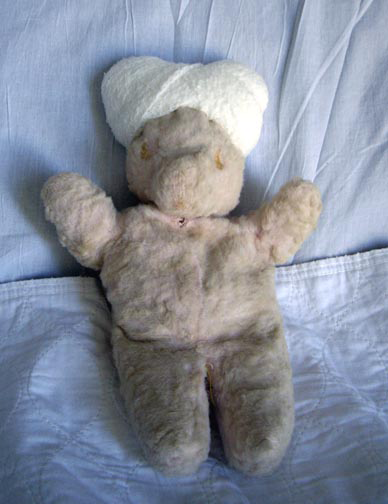
“I was so adamant to have my Teddy Bear laying on the operating table with me, because my grandmother gave it to me when I was 4 years old, the only prior time I ever was in the hospital…In all the places I have traveled and lived, I have always had it with me. When I was just coming to out of surgery, I remember one surgeon held up my Teddy Bear and said, “Your bear says it's time to wake up." I remember sort of seeing that its head was bandaged, and when in the ICU recovery room, I was clear enough to notice that the surgeons took the time and care to wrap its head, as mine was. This was such an endearing detail, which reinforced that on so many levels my surgeons and their team understood every detail, especially their patient.”

How to separate play from seriousness in this metonymic belief, shared by the doctors and patient alike? They all understood the power of an inanimate object to contain our memories, emotions, and beliefs, an object made indispensable precisely because of its lack of any practical purpose.


January 27, 2010

Need and Want


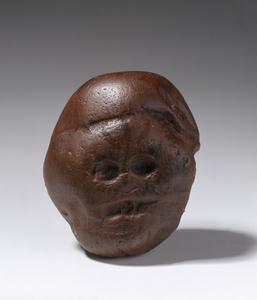
Recently, a curious posting by NYTimes columnist and writer Rob Walker appeared on his blog (www.murketing.com), a story of the Makapansgat Pebble. This anthropomorphic stone was found in what is now South Africa, and is estimated to be about 3 million years old, writes Walker. It was certainly not made by a human ancestor – in those early times they could not make anything yet.  “What’s significant about it is that the experts believe, based on the makeup of the pebble, that the spot where they found it, among ancient bones and whatnot, indicate that some hominid carried the thing several miles.”


“Why was it carried away from its place of origin? Well, obviously we don’t know the precise answer, but clearly it’s not a matter of use-value: The pebble is not functional, it’s not a tool. Whatever motivated the owner of this object, he (or she) certainly didn’t need it. And that is the message of the Makapansgat Pebble: In the history of material culture, it represents the birth of want”, concludes Rob Walker.


Aside from a fascinating insight into history of this little-known artifact, Rob’s posting is worth reflecting on from our designers’ point of view. Throughout the 20th Century, the spread and marketing of “want” was always justified by “need”. A purely symbolic, decorative object (think Philip Stark’s famous lemon juicer) had to be able to perform a function, however compromised, in order to be considered a “legitimate” design product. Most design writers and educators still insist that new products must be based on a new need.  Yet the pebble story seems to imply that in the earliest periods of history the want had actually preceded tool-making and other essential functions, which ultimately made humans human. The first souvenir came well before the first tool.


Today, the old idea of function needs to be re-considered and expanded. Things like souvenirs, collectibles, flowers, or toys enlarge human experience and form an important part of our material culture, even though they do not seem to fit a standard definition of usefulness. Products based on want without need are abound on the market, yet one can’t sell anything founded on need without want.


January 6, 2010

A Real Mendini


I got acquainted with Alessandro Mendini years before I actually met him. In the early 1980s, the Italian architect was at the helm of trendy and sophisticated Domus magazine, which in the world of publications stood out much like Apple stands in the computer industry today. Mendini’s perfect Milanese face looked straight on from the front page of every issue, where he interviewed his famous subjects. Those peculiar enigmatic interviews felt even more alluring because of my sketchy understanding of both Italian and English.

Domus Academy, where I came to Milan to study, was not directly linked to the magazine, yet Mendini’s reputation loomed larger than life over the entire school. Soon I met the man himself, who turned out to be only five-foot-four, but had an irresistible charisma. I learned also that many in Milan were unsure about his work: his message was too complex, too personal, and not too optimistic. Who else would dare to title his own monograph The Unhappy Design?

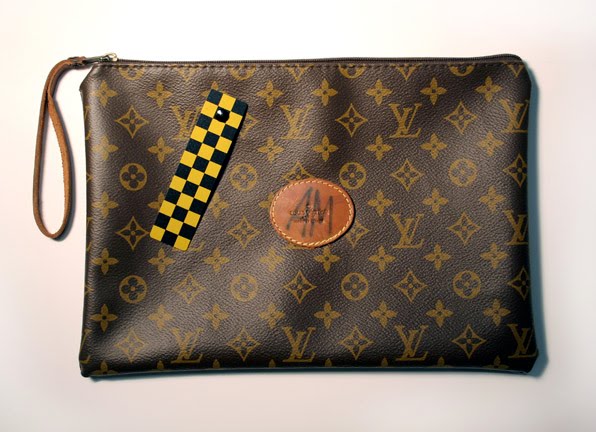
A good example of Mendini’s attitudes was a one-time performance, sometime in 1984, of which I kept an unusual souvenir: a fake Louis Vuitton purse. The counterfeits’ market was flourishing in Milan twenty-five years ago, as it probably continues to this day. The business was conducted on the street, mostly by vendors from Africa, known as “the Senegalese”. For the event, the architect had invited several of the men into an art gallery, along with their illegitimate wares. There was music and vine. Guests could buy a counterfeit bag, quite cheaply, and Mendini would then validate their purchase by attaching a new checkerboard tag and placing his initials over the old label. A fake Vuitton would become an original Mendini.

Many of design preoccupations of the time had found reflection in this simple gesture of the architect: the theme of banal object and originality, the politics of design, the redeeming quality of decoration. Above all, it had a fleeting lightness of a game. Soon the event was forgotten; I do not know how many redesigned bags, if any, remain today.

Around 1985, Alessandro Mendini joined forces with his architect-brother, Francesco, starting a second, “happy” phase of his career, which ultimately brought him much commercial success. By stroke of good fortune, I landed my first job after graduation in Mendini Brothers’ new architectural studio. Their first and only project was an unusual house on the lake Orta, entrusted to them by Alessandro’s old-time friend Alberto Alessi. Mendini’s concept was to extend his ideas of collaborative design to the scale of a villa. Different parts, designed by the likes of Michael Graves, Robert Venturi, Sottsass, even Frank Gehry, were to be merged into one coherent, decorative composition.

On my first day at work, Alessandro said with his characteristic smile: “Let’s play this game together.” Compared to my experience at American architectural offices, his work process did resemble playing. The architect would through around some outlandish ideas, which somehow would make a perfect answer to a problem at hand. Once, after we struggled in vain to line up the parapets of two joined roofs, he finally offered: “Let us just build the roofs first; then we’ll go up there, and figure it out.” Unfortunately, I did not have a chance to climb that roof. My calling soon brought me back to New York. Alessandro Mendini moved on to become a creative director at Swatch, and the brothers had built a host of Swatch stores around the world. We even managed to collaborate again – but that’s another story.