Friday, December 19, 2008

Thinking of Tibor


Some New Yorkers remember Andy Kaufman’s famous after-concert party when he invited the entire Carnegie Hall audience for milk and cookies. Well, I have not been there. But I do remember Tibor Kalman’ s equally remarkable supermarket party, ten years ago, when his long-awaited book arrived from the publisher. (Tibor Kalman: Perverse Optimist, Booth-Clibborn, 1998)

The invite featured milk bottles in a refrigerated deli case - you could expect anything from Tibor. Arriving at the given address, I did not expect, however, to find a local Gristede’s as a party locale. Everything in the supermarket was left untouched; they only turned off the overhead lights. The place was eerily illuminated by concealed shelf lighting in the aisles. (Every supermarket has this kind of lighting – yet I have never noticed it before.) A jazz band was playing somewhere; people sipped champagne, looking at the shelves with attention worthy of a museum show.

Towards the end, Laurene and I looked for Tibor, to offer our thanks and congratulations. “Did you get a souvenir?” he asked. I did not understand. Already in wheelchair, he turned around and picked a random can from the shelf. “June peas, they are the best”, he said with satisfaction, and signed the can.

I still have this can, ten years later. Here it is.

Wednesday, December 10, 2008

Holy Chrysler


W
orshipers at Greater Grace Temple, a Pentecostal church in Detroit, prayed on Sunday, December 7, for an automobile industry miracle. Three S.U.V.’s on the stage, a Chevrolet Tahoe, Ford Escape and Chrysler Aspen on loan from local dealerships, were all gas-electric hybrids, and Bishop Ellis urged worshipers to combat the region’s woes by mixing hope with faith in God.

Can this be real - or is this another Saturday Night Live spoof? According to Steven Skov Holt, events like this fit into “today’s pattern of post-credibility”. “The news regularly stuns us with one improbable story after another. Even when something bizarre but undeniably real happens to us, our first reaction is often one of disbelief.” (see Steven Skov Holt and Mara Holt Skov, Manufractured, Chronicle Books, 2008)

It is not surprising that today’s art, architecture, and design become more exuberant and almost unbelievable in scale, technique, and complexity. It is getting increasingly hard to simply compete with reality.

Friday, October 31, 2008

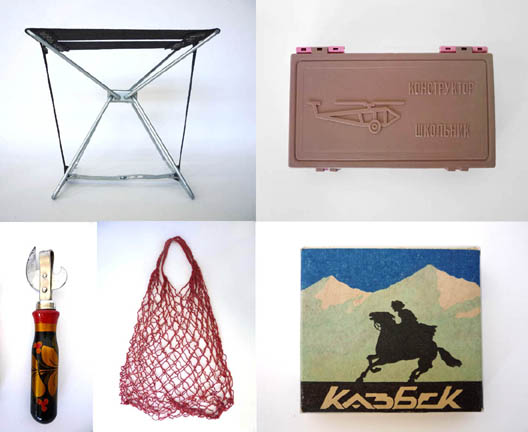
Extinct: Products from the Soviet State Store

Soviet consumer products always reminded me of weeds. Cheap, anonymous, notorious for their clunky robust look, they proliferated in great numbers at all levels of Soviet society. Like the Soviet State itself, it seemed they were destined to live forever.

Once Russia turned capitalist in the early 1990s, it was only a matter of time before “the weeds” got cleared out. Presently, most Soviet products are extinct, or at least endangered; perhaps they still could be found on flea markets, or far in the provinces. We picked them at random during our early visits to Russia, driven, in part, by collectors’ instinct, in part – by a desire to amuse our American design colleagues.

Today, these products may still amuse someone, but their unpretentious simplicity can also teach us a few design lessons. Eventually, they will pass into the realm of historical artifacts. In November 2008, part of our collection has been presented in a small exhibition at KIOSK Gallery in New York City. A few highlights are shown below.


Wednesday, October 22, 2008

Tiles of Disaster


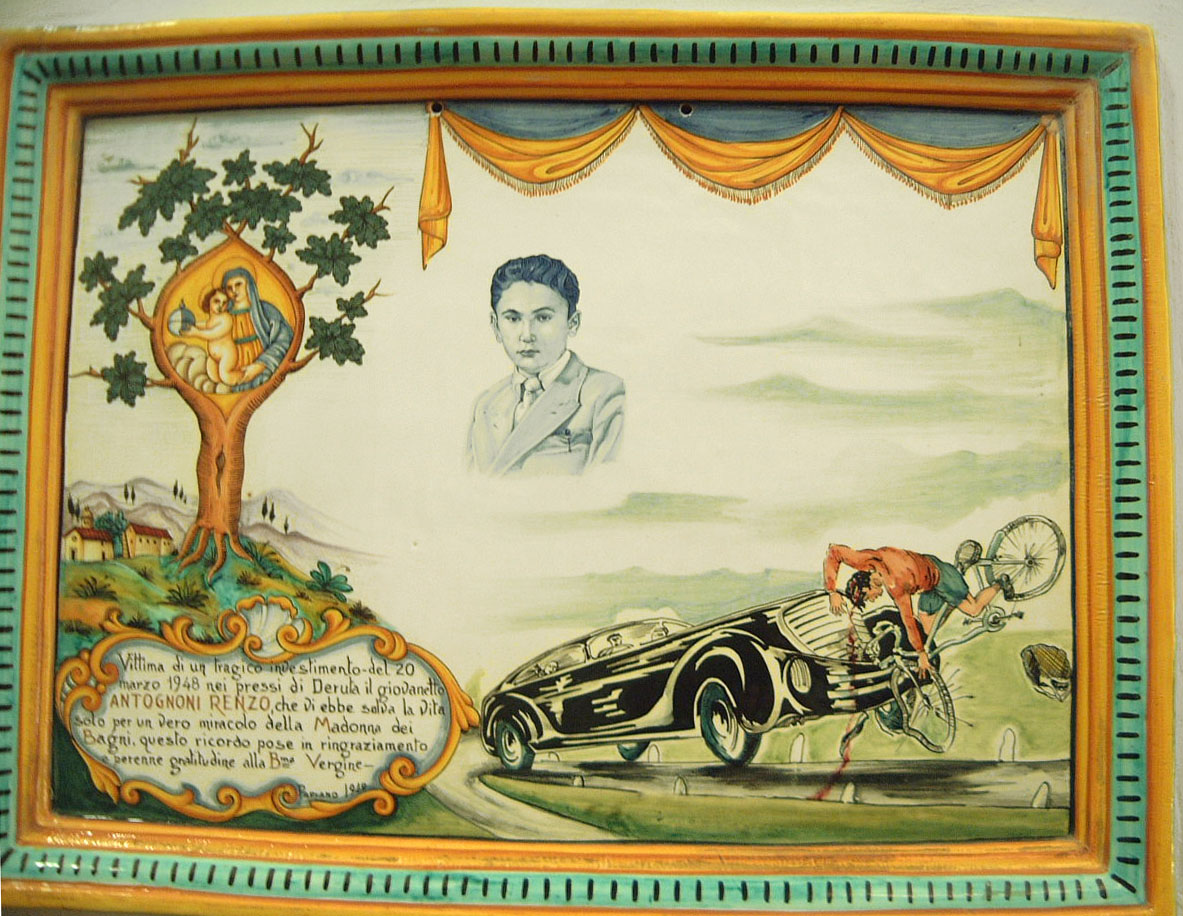
Deruta is a charming Italian town known for its ceramics, universally judged best for its quality of hand-painted decoration. For me, the most unusual of Deruta’s sights was a small church of Madonna dei Bagni, located on an undistinguished highway just outside of town.

The church is filled with ceramic votive plaques, given to the Virgin for saving one from an imminent disaster or death. The plaques, known as PGR – an acronym for Per Grazia Ricevuta (For Saving Grace) – show in graphic detail car and airplane crashes, muggings and fires, falls from a tree and vicious dog attacks. The oldest ones date to the 18th century; the newest are only a few years old.

These strange artifacts never fail to amaze. It is hard to imagine a more startling and disturbing clash between a traditional craft and our contemporary tabloid culture. Remarkably, the tiles have been done without a trace of irony, not by hipster-artists, but by devoted craftsmen who believe in redeeming quality of their (unsigned) work.

Tuesday, September 2, 2008

Waste


W
hen I arrived into this country in 1981, the two first American books in my new home were the Yellow Pages and the White Pages, handed to me by the telephone company's rep in Boston. I remember proudly placing them on a bookshelf, next to my favorite Russian books and other treasured possessions. These two thick volumes contained everything I might possibly need. Their reassuring presence held promise of connecting me to a new world, with all its unlimited possibilities.

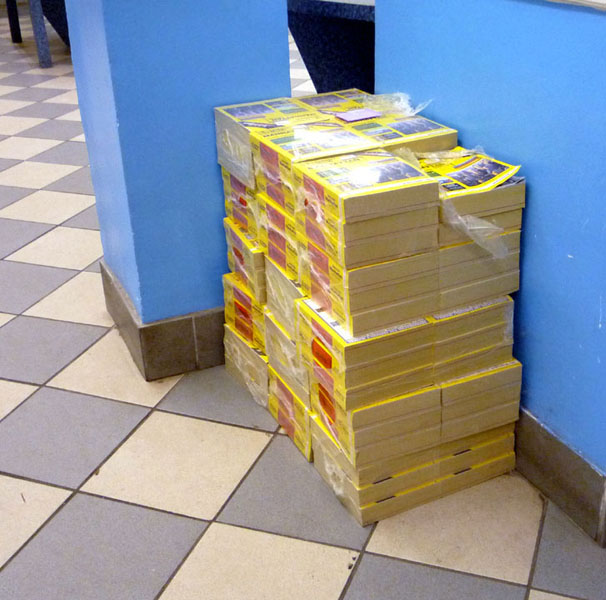
Fast forward to 2008. It is strange that telephone books, these pre-Google dinosaurs, have even survived to this day. What is even stranger, is that they are still delivered en masse, free of charge, to the doorsteps of every residential and commercial address. Most often, the unopened pallets are moved straight into garbage or recycling pick-up areas, to be carted away a day or two later. If this is not waste, what is?

Thursday, July 3, 2008

Excess


What do you give to a person who has everything? Many American manufacturers, retailers, and catalogue businesses seem to be perpetually preoccupied with this question.

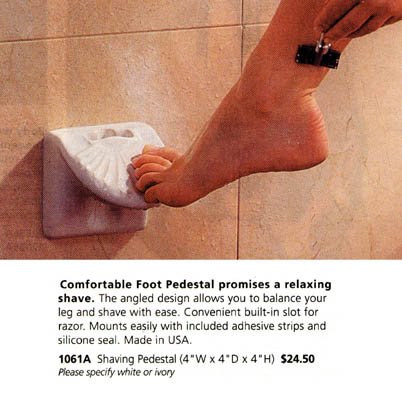
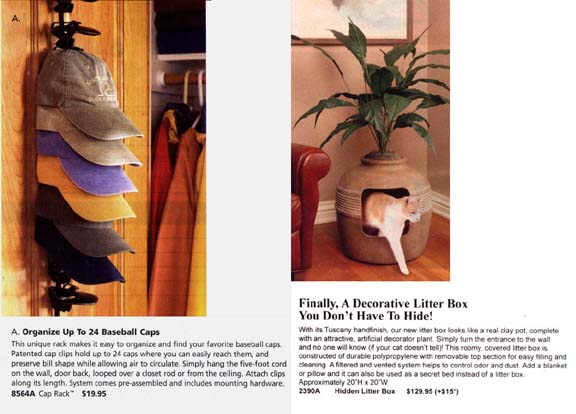
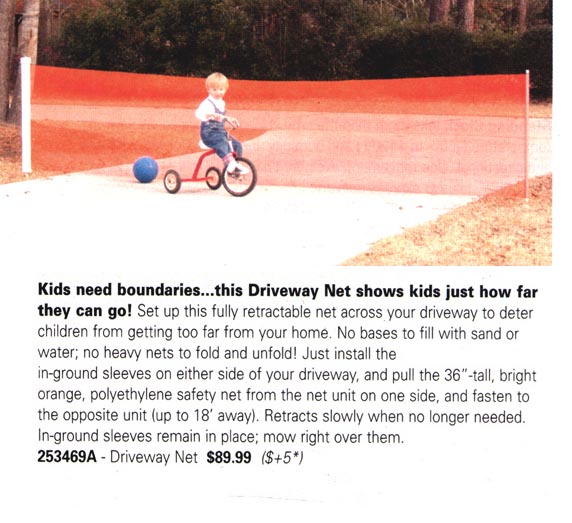
Below is a selection of sometimes funny, sometimes marginally useful, but inevitably superfluous products, made available through in-flight magazines and catalogues. This random selection provides a curious insight into continuing intermingling of High and Low, a pervasive trait in American culture. In the featured merchandise, one could find, for example, obvious Pop Art references (Storage Center for 53 Batteries; Rack for 24 Baseball Caps), elements of Magritte-like Surrealism (Realistic Boulder to Disguise Yard Problems), or pieces worthy of American Minimalist Art (Driveway Net).

Do these objects really sell? 


Thursday, June 26, 2008

Glorious Sandals


Occasionally, an everyday object with no special significance starts to loom large and meaningful in a different culture, in a faraway part of the world – as if in some parallel universe. Consider plastic sandals – a kind you pick up in 99c stores all around America. This unlikely object stands as a monument on a city square in Asmara, the capital of Eritrea. The small East-African country split from Ethiopia after the long civil war in 1993, yet the struggle for independence continued well into the late 90s.

“It’s what all our fighters wore,” the New York Times quoted Eritrea’s ambassador to the US, who had a pair of sandals himself. “ We didn’t have uniforms. That was our uniform, and it became a symbol of our independence.” Machines for making sandals (“shida”) were set up near the front. Whenever a strap of a shida broke, it could be quickly fixed with a small flame by melting it back together.

This Oldenburg-like monument reminds us about relativity of values we attach to objects of our daily use. Is there a giant toothpaste memorial out there, somewhere?

Wednesday, June 25, 2008

Wearing Hemingway’s Cap


J. Peterman Catalogue looks different from the bundle of similar offerings that arrive weekly in the mail. It is white; instead of assertive photos of male and female models, there are delicate watercolor renderings of clothes and merchandise. None of it appears too distinctive or special, until you start to look and read closer.

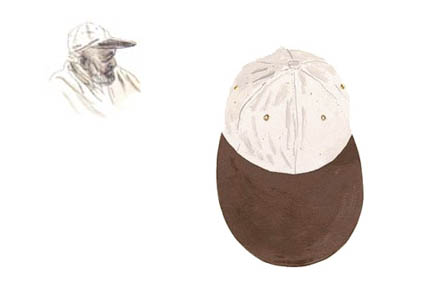
A shirt on sale is a copy of one worn by Thomas Jefferson, a striped t-shirt was spotted on Picasso in St. Tropez, and a long-billed cap once belonged to Hemingway. “He probably bought his in a gas station on 
the road to Ketchum, next to the cash register, among the beef jerky wrapped in cellophane,” – intones the catalogue.

How does it feel to wear a copy of Hemingway’s cap? Do you feel empowered? amused? – or does it make a cute conversation topic? (I am tempted to order one and try it out.)

These references to cultural history clearly endow J. Peterman merchandise with a certain aura. In a highly saturated fashion market, these humble, not-inexpensive caps and shirts are able to stand their own ground. Fashion industry is always the first to tap into consumers’ hidden cultural desires. I could see product and furniture design following suit. Could offerings like John Lennon’s bed be far behind?

Wednesday, June 18, 2008

World's First Mass Product

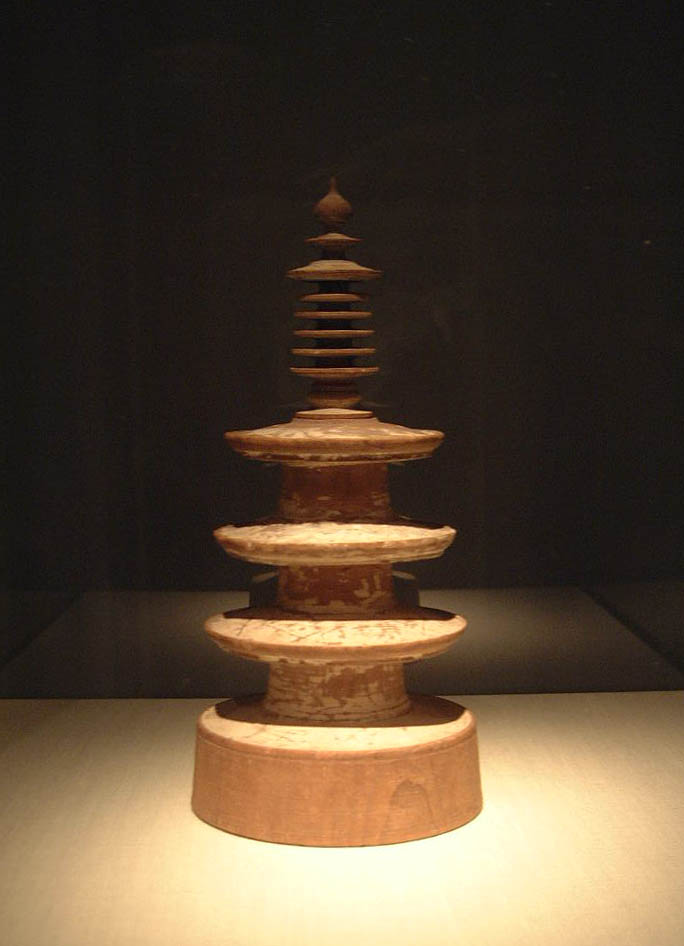
In the exhibition of Japanese photographer Hiroshi Sugimoto, his images were interspersed amongst a peculiar selection of Japanese antiques. I was immediately attracted to the beautiful wooden miniature pagoda in the museum vitrine.

After civil disturbances in the 8th Century Japan, a new empress commissioned the production of these miniature pagodas for the repose of the souls of the war dead. ”Over a period of six years,” – writes Sugimoto, – “one million miniature pagodas were made and distributed to ten major temples (each receiving 100 thousand). Of the complete set, 45 thousand are estimated to survive to the present; the other 955 thousand were burned, discarded, or destroyed, disappearing in the intervening 1200 years of history”.

It is perhaps not so surprising that this impressive (even by today’s standards) mass production did not create a functional utilitarian item. Amidst poverty and war, instead of making a million chairs or bowls, the craftsmen concentrated their superhuman effort on producing miniature buildings! Today many would call them tchotchkes, back then they were considered indispensable for religious fulfillment and emotional consolation.

Could this first mass produced object be considered a paradigm of design? Or is it just a curious footnote to the debate about functional vs superfluous?

Tuesday, June 10, 2008

Roadside Surrealism


Lautreamont famously defined Surrealism as “the chance encounter of a sewing machine and an umbrella on a dissection table.” His formula underscored the essential quality of the surreal: a strange combination of unmatchable things intended to stir one’s imagination and emotions.

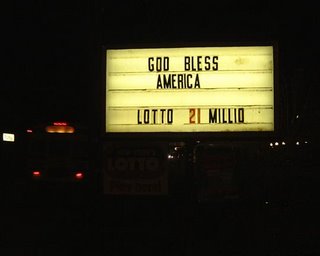
In the aftermath of 9/11, the words GOD BLESS AMERICA were featured on road signs of many American businesses, in a spontaneous display of solidarity and compassion. Since business had to go on, the patriotic statement was immediately followed by a completely unrelated pragmatic or commercial proposition. The billboard’s overall message read like lines of a strange Surrealist poem.

These billboards remained in place for several months, through most of the winter of 2001. Remarkably, the strangeness of the effect was perceived by no one but most acute observers.